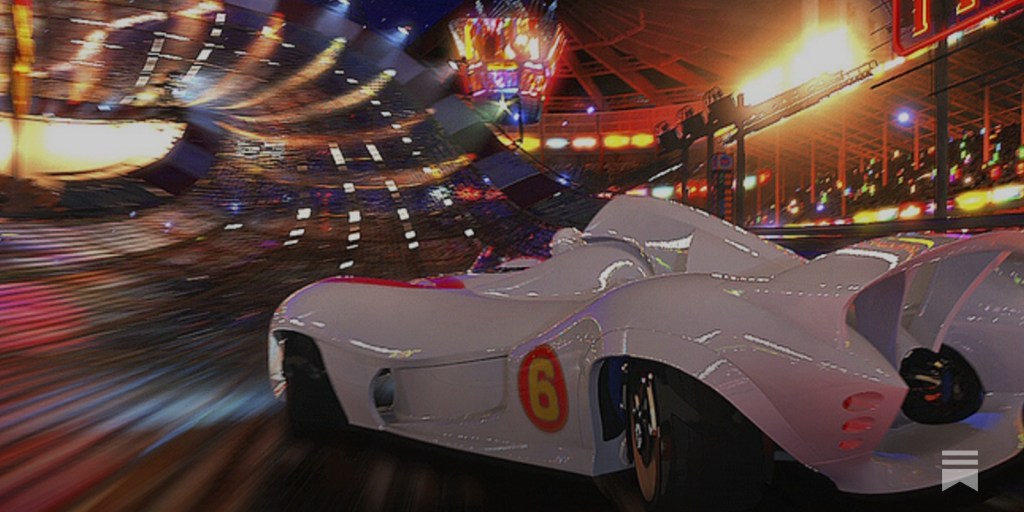
Let’s talk about unhinged artistic ambition. Let’s talk about filmmakers reinventing themselves. Let’s talk about the strange environment of adaptation. Let’s talk about one of my favorite movies.
Let’s talk about Speed Racer.
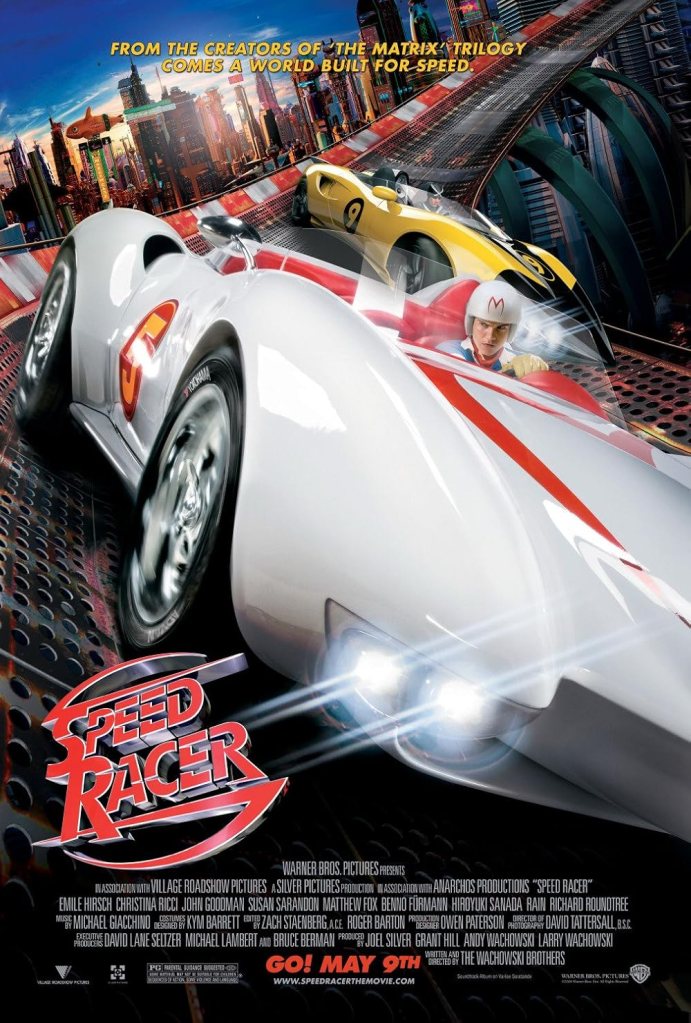
Written and directed by Lana and Lilly Wachowski and based on the 1967 anime series (itself an adaptation of Tatsuo Yoshida’s manga Mach GoGoGo), Speed Racer represents the Wachowski Sisters’ first major feature after the wild success of their Matrix trilogy. Yes, I know Lily made a fourth Matrix, and that could be the subject of a later Silver Linings Defense Force post, but at the time the Wachowskis wanted to move on from their decade-defining work of genre filmmaking and use their considerable talents to make a visually unprecedented family film. Warner Bros. gave them $120 million to go nuts, then released it in May 2008, squeezed in between Iron Man, The Chronicles of Narnia: Prince Caspian, and Indiana Jones and the Kingdom of the Crystal Skull, and left it to die. Speed Racer went on to earn $93 million worldwide to mixed if not outright hostile reviews (it currently sits at an underwhelming 42% on RottenTomatoes) and baffled audiences before disappearing from theaters and the cultural consciousness.
And I loved it.
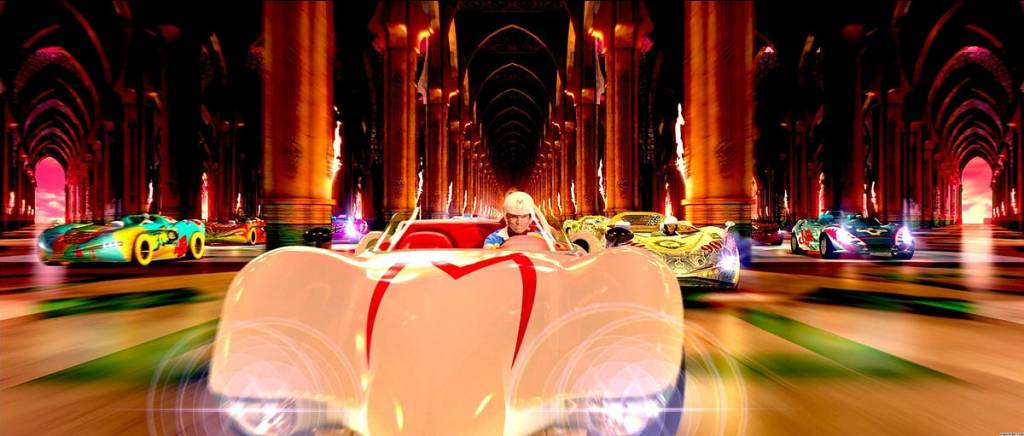
For those of you not in the know, Speed Racer is about the Racer family and their middle son, first name Speed (is it really that much of a surprise he’d grow up to drive cars?). They’re mechanics, and Speed (played by Emile Hirsch) makes it his personal mission to be the very fastest driver around despite his lack of corporate investment. See, his family’s got heart, and racing is as much in his blood as it is on his birth certificate. They’re still shaken from the accident that (presumably) ended the life of Speed’s older brother, Rex, who Speed idolized as a boy. His younger brother, Spritle (played by Paulie Litt, he of the chimp companion), feels the same way about him. Speed’s mother (Susan Sarandon) loves him unconditionally, and his father Pops (John Goodman, electric as always) does as well, but he’s nervous that Speed may have his older brother’s recklessness. All of this is conveyed in the first 10 minutes of the film, intercut with a thrilling race sequence that gets viewers acclimated to the Wachowski’s hyper-kinetic, uncompromising style.
The key to enjoying Speed Racer is not to overanalyze each element of these impossibly stitched-together shots. Let the rhythm of the scene wash over you. Let it happen. This is not a live-action film; this is an anime that happens to star flesh and blood actors. The CGI backdrops aren’t invisible or 100% realistic, because they’re not trying to be. The point is verisimilitude. No movie looks like Speed Racer. It’s likely no movie ever will look like Speed Racer, considering how hard it flopped at the box office.
But it’s incredible how much this sequence accomplishes, introducing a sizable family and all their interconnected relationships and showing how Speed still venerates Rex. The use of the “ghost car” is an ingenious visual device, and the way Speed lets it win tells us everything we need to know about his integrity.
Though that integrity will be tested, because Speed Racer is not just a movie about a guy who Drives Cars Real Good (TM). No, Speed Racer is a movie about how capitalism destroys everything pure it touches.
Enter Arnold Royalton (Roger Allam).
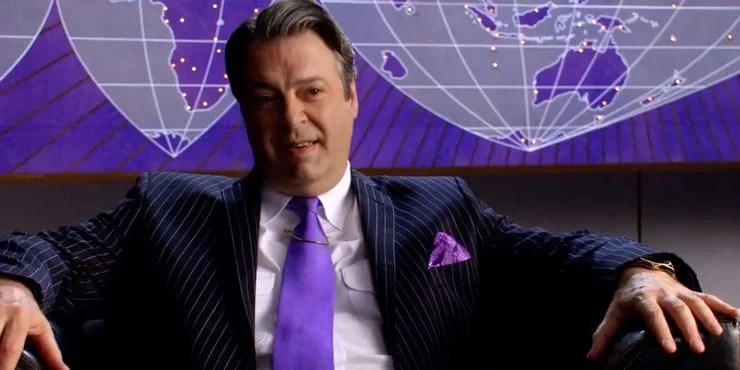
Look at him, in that purple on purple on purple outfit. In Speed Racer, purple is the color of evil itself. When he shows up at the Racer home unannounced, he pauses his plan of recruiting Speed to join his racing team long enough to inquire about buying the recipe to Ma Racer’s pancakes, with a contract and everything. It’s not enough for Royalton to be outrageously wealthy, because pursuit of capitalistic excess never leads to satisfaction. He needs that line to go up, forever and ever, amen, no matter how unnecessary, no matter who he hurts.
As he explains to Speed during a tour of his facilities, racing isn’t about the cars or the drivers. It’s about money. When Speed turns down Royalton’s contract, sharing a story about watching a race with Pops to heal from the loss of Rex, Royalton retorts by revealing the race was fixed in an act of corporate, well, evil. He assures Speed there will be no more winning should Speed refuse him, that there is no room for earnestness in the thing Speed loves most of all in the world (besides his family).
And for a moment, he seems to be right. Speed is wrecked at his next race, and he’s looking down the barrel of Royalton’s business and legal might. That’s when Racer X (Matthew Fox, of LOST fame) shows up, offering Speed the opportunity to pull one over on the Royaltons of the world.
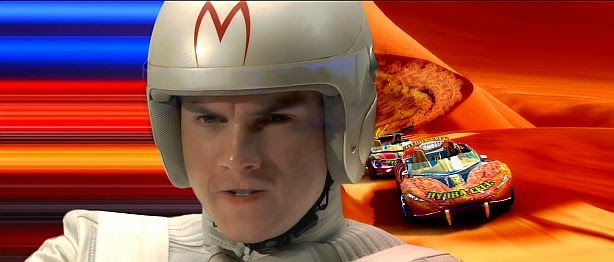
From here on, the film is a whirlwind of visually stunning races, big emotional beats, ninjas (sorry, non-jas), revelations, and payoffs, all set to Michael Giacchino’s all-timer of a score. There’s no way to describe the scenes in a way that sells what it’s like to see them, and perhaps that’s part of what made this movie so hard to market. The only way to understand what Speed Racer is, is to watch it. Turns out, the same marketing tactic used for the first Matrix can describe a lot of the Wachowskis’ filmography.
No one else but the Wachowskis could have made this film. I don’t mean that just in the sense of, “the Wachowskis did something crazy with The Matrix and had the ability to convince a major studio to bankroll this,” but also because the Wachowski Sisters make big, earnest movies that can sometimes be cool, but aren’t concerned with being cool at the expense of the characters and themes they want to address.
Because the truth of the matter is, they made a movie about how genuine love of something wins out over cynical capitalist interests in the end, and at the box office… they lost to two big genre sequels and the start of the Marvel Cinematic Universe.
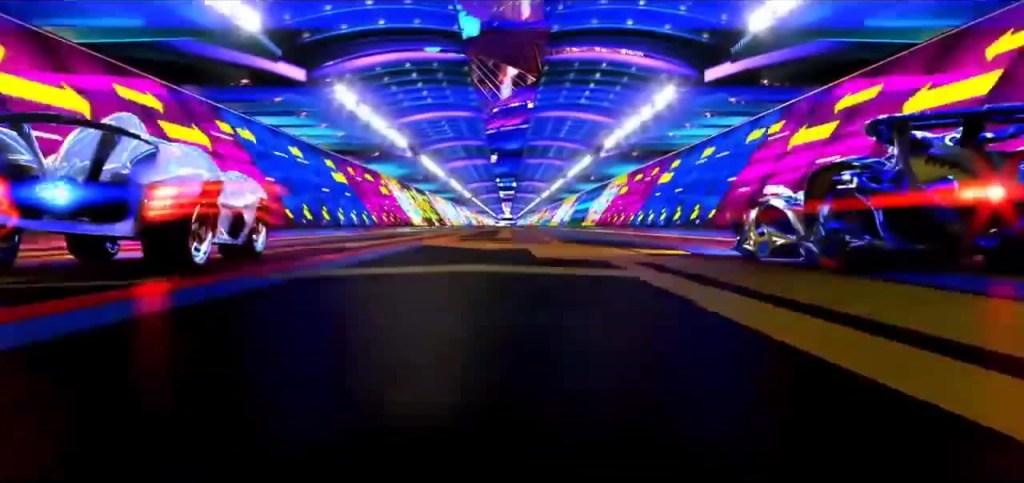
But then again, when Speed took on the Royaltons of the world, he lost at first, too. Capitalism always wins… for now. But in the long run, were they wrong? Sure, Iron Man has stayed in the cultural consciousness, but I’d argue Speed Racer is already remembered more fondly than the Narnia movie where Eddie Izzard voices a bloodthirsty mouse (best part of the film) and the Indiana Jones flick with Shia LaBeouf and the flying saucer at the end (even if that one’s overhated as well).
The Wachowskis made something original, even as they made an adaptation. Warner Bros. might have been willing to give them $120 million, but not $120 million on a fully original IP. But they used it as a chance to say something anyway, and say it in eye-watering color.

All of us artists are forced to make art under capitalism, a system that devalues us, that doesn’t believe we have value on our own unless we’re able to indicate we can make that line on a graph go up. But real artists? Real artists don’t give into despair. Real artists keep making art, because it’s what gives the world color.
Partway through the film, Speed bemoans that, “Racing hasn’t changed, and it never will.” He feels beaten down, and understandably so.
Racer X replies: “It doesn’t matter if racing never changes. What matters is if we let racing change us. Every one of us has to find a reason to do this. You don’t climb into a T-180 to be a driver. You do it because you’re driven.”
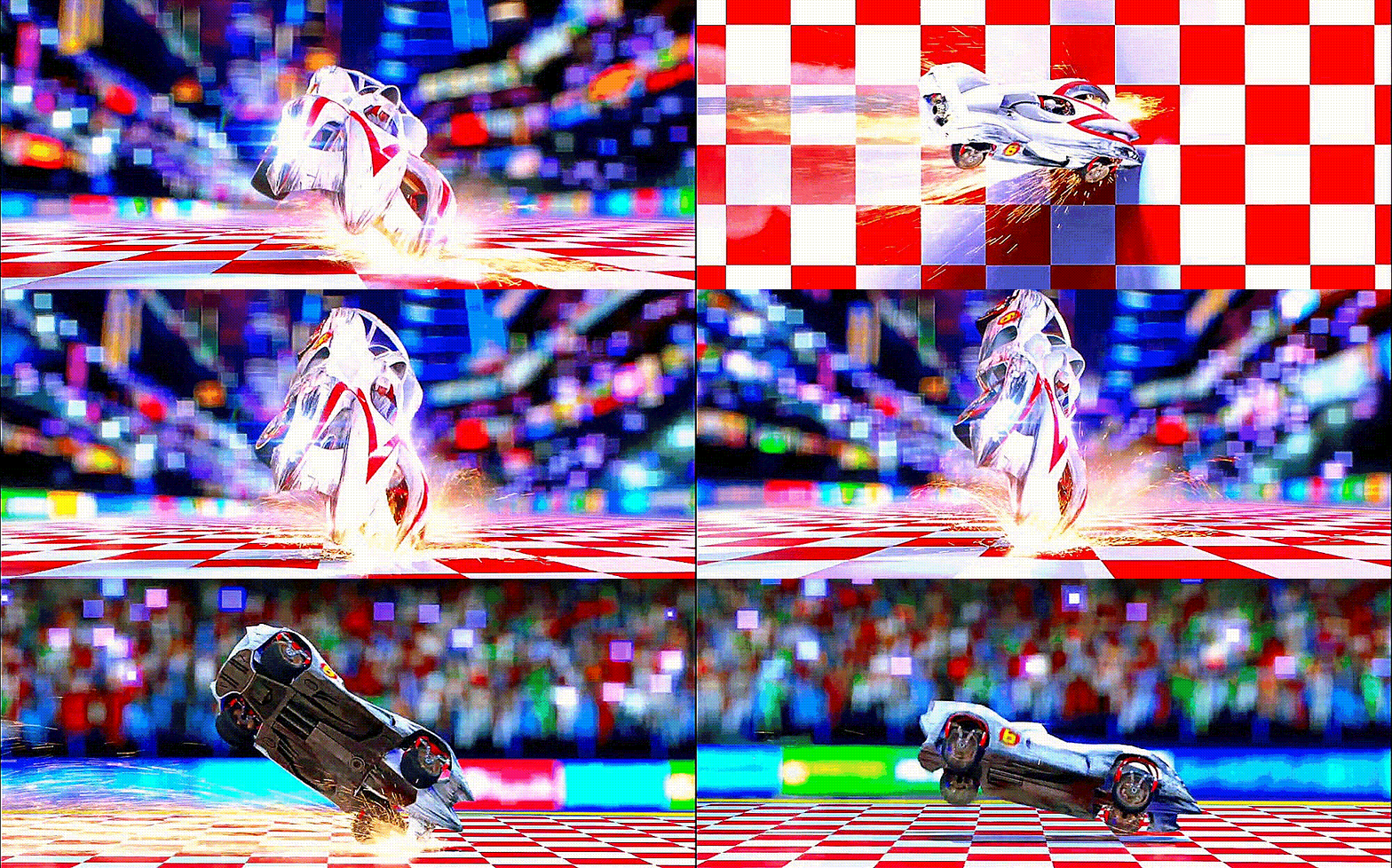
So we keep making movies, or writing books, in my case.
Speed Racer has undergone something of a critical reevaluation in recent years, which lets me put on my “I Told You So” cap, albeit with my arms wide open. Yes, it’s got a bonkers visual style. Yes, it’s often very silly, cheesy even. And it’s one of a kind. When the Wachowski Sisters are gone, no one will care how much money The Matrix Reloaded made (it’s a lot, if you’re curious). But they’ll still rewatch Speed Racer, because no other movie hits quite the same way.
At least, I will.
And speaking of supporting artists: if you like what I have to say about movies, you might also enjoy Rapscallion, my swashbuckling fantasy heist novel. I promise you, I won’t use a spearhook to boost sales.

 Trey Weller
Leave a comment